Orkut: A Shooting Star

Just like a shooting star burns brightly and then fades into darkness, Orkut, too was center stage for a short amount of time. The social media networking site was a popular digital location for people to hang out, especially in Brazil.

Target Audience

This was an exclusive site that catered to well-connected and tech-savvy individuals. The company had quite a few strengths within their marketing action plan, but key lacks ultimately lead to their demise. The tech industry is tight knit and interconnected, so Orkut did a great job with their target audience and the fact that it was an invite-only network.

Policies

Another area Orkut excelled in their media plan was privacy policies. With technology professionals being at the core of their demographic, this was critical. It makes sense that people who are involved with privacy matters and actually understand the policy jargon would be interested in what this entails. Orkut listened their consumers and created infrastructure within their product around this.  

Monitoring

Orkut had some strong brand identity and connection with their consumers, but where they failed to execute was within the monitoring step of a marketing plan. It is important for an organization to listen to feedback once they launch. Companies can gather a lot of information about their product through digital channels and communication. This was especially true for Orkut, as they were actually the digital channel people were using. This lack of listening was the downfall for Orkut. Consumers and advertisers alike heavily used images and video, two pieces of media Orkut did not cater towards. It is unfortunate for Orkut that they were not able to get this piece together, as we know images and videos rule the internet today. Mark Zuckerberg from Facebook is quoted as saying “video is going to be a megatrend” back in 2017. Zuckerberg had the foresight to cater to this need, an element Orkut was not able to meet.

Cultural Context

Internationally, advertising is everywhere. We are used to seeing bus benches, freeway signs, tv placements, social ads, among many other channels. Advertisers use these methods to push their content and ultimately drive sales for their companies. So what do you do when a major channel is taken out? Brazil has the unique trait that outdoor marketing is not allowed, which lead to an engaged online marketing landscape.

Brazil as a country was a ripe opportunity for Orkut to take advantage of. With the advertising ban combined with positive online shopping experiences, there was room for Orkut to cater to a generation and community like never before. Consumers wanted videos and photos, advertisers wanted to appeal to customers with visuals, but Orkut was not able to deliver for either demographic.

Takeaways

I would suggest companies focus efforts on both listening and responding to consumers if they want to have a chance of surviving. With so many options for products, content, and channels, providers need to be responsive to needs. Consumers don’t have a shortage of opinions, so it might be time for your organization to make use of these opinions before you flame out like Orkut.


Weixin: The One-Stop-Shop for Digital Natives

Weixin is a social media application based in China, providing a variety of engagement activities to their users. This technology integrates multiple application functions, including text messaging, sending images, and taxi services.

We have all heard the phrase “attention spans shorter than a goldfish”, and this rings true now. Not only do we have that short of dedicated focus, but Time states we actually have shorter attention spans than our fishy friends. So how can our ability to focus impact apps?

People get tired of one thing very quickly and want to move on to the next stream of entertainment. Weixin saw an opportunity in China, and capitalized on it. Users are still able to have their limited attention, but never have to navigate away from their service.

By being user-centric in their design and consistently adding new features, Weixin is able to stay relevant and keep users within their singular app.

While this is a great opportunity for Weixin, what problems could users face?

With so many functions living in one application, there is the possibility of not having quality software. A mile wide and an inch deep is a real concern. The company could be spreading itself so thin to accommodate new features and functionalities, while ultimately giving up quality in the features they do have.

In addition, there is the possibility that the features get stagnant. With consumers living in one app, it could be hard to get them to search elsewhere. This nixes the option for competition, so Weixin may not feel the need to improve their offerings if it is the go-to for so many consumers.

It is important to stay connected digitally, both personally and professionally. Weixin was able to leverage this need with the desire for ease of use. By creating the option for anything anyone could ever need in a phone application, the company is able to keep users coming back.

Breast Cancer Awareness vs #ALSicebucketchallenge

Social media provides an opportunity for people all over the world to connect that may not have otherwise. This channel can be leveraged in a variety of ways, one of which being mobilization. According to Mahoney and Tang, there are a few key elements that help a movement go viral. These include the ability for a user to create their own identity in the movement, engaging with them along the way, and encouraging participation.

While these aspects can help a movement go viral, the Breast Cancer Meme example demonstrates that it’s not just about checking off boxes.

During Breast Cancer Awareness Month, users were encouraged to participate in a variety of activities on social media, posting about their bra color but not including what they were posting about. The goal was to “have the men guessing”. Many women participated in this and it did encourage participation.

The downside? There was no tangible result.

Personalization, purpose, and feeling part of something help to create the illusion of “helping” the cause. In reality, there was not a tangible impact. The call to action had nothing to do with raising awareness or donating, so it fell short of mobilization. The impact was lacking.

The campaign did encourage people to engage with the content and certainly checked off the boxes around how to help a movement go viral. While it may have caused a stir, it did not lead to users being more informed or making a contribution to the organization.  

To make viral social media efforts impactful, experience and participation must be connected with an outcome.

The Ice Bucket Challenge is a great example of how this concept can be leveraged to have an impact.

People were encouraged to take a video of themselves dumping a bucket of ice water over their heads, posting it on social media, and making a donation to support ALS. This social media phenomenon had people confused, but they were able to learn more about it with posts that included #ALSicebucketchallenge. By connecting the activity to the movement, people were able to understand what the purpose of the content was for.

This movement is a perfect example of what the Breast Cancer Meme could have been, and highlights where it fell short.

Both activities were viral and were based on social media, with the purpose of raising awareness and funds for an organization. One reason the ALS movement may have been more successful is the offline engagement element. People feel more connected to an activity and are willing to take action if they participate in the physical world (Mahoney and Tang). People had to participate in the activity in their personal life to create the content. We know user generated content is gold, so this combination was powerful for the ALS movement.

The Breast Cancer Meme had great elements, but needed to take the activity to the next level by connecting their purpose with the mission, and having a tangible action for viewers to take.

How do you make a mundane task Insta-worthy? Just ask Warby Parker.

I hate making appointments. Figuring out the right number to call, taking time out of my work day to reach them during business hours, calling and being redirected, being put on hold endlessly, trying to figure out when my schedule will overlap with availability when the call is finally answered. One of my least favorite adulting activities.

Now, imagine this: a world where you don’t have to deal with the hassle. Thanks to Warby Parker, you can now get glasses without the headache.

How it works:

  • Use your existing prescription or get a new one at a Warby Parker or other store, no appointment necessary. Do it when it works for you.
  • Take the online quiz for suggestions, browse frame options on the website, pick 5 of your favorites to try on.
  • Receive the frames in the mail, poll your friends on Instagram, and pick your look.
  • Return the try on frames and place your order. Easy and on your own time!

This is clearly the better way to buy new glasses.

Digital first

Warby Parker is an innovative company that changed the landscape of eyewear purchasing, brining excitement to an otherwise uneventful process.

The success of Warby Parker is partially due to the digital nature of their company. Nearly the entire process is online, with users having access to the site whenever they choose. By meeting customers where they already are (online), the company is able to decrease barriers and make the purchase process easier.

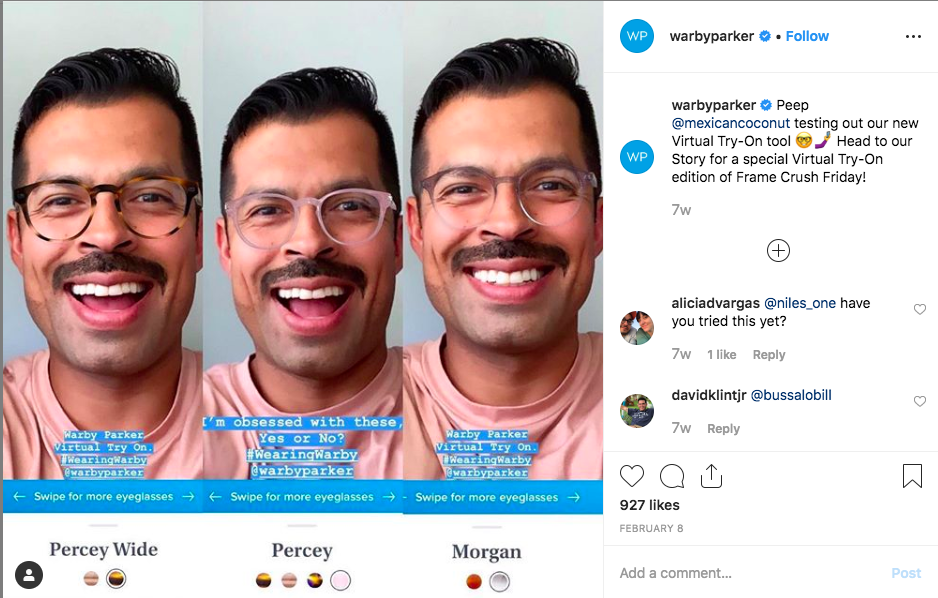
To further engage customers digitally, Warby Parker has come out with an app that allows people to virtually try on glasses. This approach is the premise of the company; ease of use.

Image from Warby Parker Instagram account

If the company was in a traditional media environment, it would be much more difficult to stand out from the competition. Print catalogues would have to be sent out to customers and the reach of the company would be limited. By leveraging their digital first approach, Warby Parker is able to connect with many more constituents.

In addition to their digital technology approach, Warby Parker uses social media to drive home their message and connect with customers. The company does not simply talk at people, but rather have a conversation. Customers receive feedback from the organization on social posts, have their videos and photos shared, and can communicate via text with questions. By opening the channels of communication and focusing on transactional communication, Warby Parker is creating buy-in for consumers. 

The perfect example

A friend at work recently realized her vision was not as clear as it once was, so like any good millennial, she turned to her network. She had seen social media posts and other friends try Warby Parker, and decided to try it out herself. Sam went online and had her try-on frames sent directly to the office so she could get feedback. After narrowing it down, comparison shots were posted to her Instagram story and friends were asked to help her decide. This type of content is pure gold for a company. Non-sponsored people using the product, engaging their friends, and tagging their company is what every digital-forward company hopes for.

To further encourage this participation, the company created #warbyhometryon. Over 24,000 users have self-identified their use of the product.

Image from Warby Parker Instagram account

Warby Parker uses this content to share on their social sites, making their brand more relatable. Using real people allows future customers to connect and see themselves in the ad more so than with a model or generic marketing message.

People are more willing to trust someone they know as opposed to a company, so users promoting products to their friends is a very powerful persuasion tool. Consumer Affairs has a great article about trust and brands, explaining that consumers are wary of messages from brands, and rely on information from people they know to make choices.

Warby Parker has harnessed the power of people, making their brand stand out in an otherwise mundane process. This company has made trying on glasses fun, instead of a hassle.